
SME ESG Reporting Standard

Sustainability Reporting for SMEs: A Guide to the Voluntary Standard (VS)
Lenders and customers are increasingly demanding transparency in sustainability. ESG Lift guides you seamlessly from data collection to your completed sustainability report – in full compliance with the Voluntary Standard (VS), without the need for costly consulting.
How it works: Simple ESG reporting
Create your finished Voluntary Standard (VS) report in 3 simple steps
- 1
Guided ESG Data Collection
No complex jargon: Our esg reporting software asks clear, straightforward questions about your company and automatically calculates key sustainability performance indicators – goodbye Excel.
- 2
Environmental KPIs & Corporate Carbon Footprint
Input your energy consumption, fleet data, and emissions – our software automatically calculates CO2 equivalents for Scope 1, 2, and 3 ESG reporting.
- 3
Social & Governance ESG Data
Employee metrics, diversity data, and governance disclosures managed according to the Voluntary Standard (VS) structure – featuring integrated explanations for every ESG reporting field.
Why ESG Lift – Driving Sustainable Corporate Growth
Everything SMEs need for professional ESG reporting and sustainability management
Voluntary ESG Reporting Standard
Comprehensive coverage of all mandatory disclosures in accordance with the EU Voluntary ESG Standard.
Carbon Footprint
Fully integrated hybrid carbon calculator in accordance with ´GHG Protocol standards
AI ESG reporting
The AI assistant generates all qualitative content in compliance with the Voluntary Standard (VS) format, streamlining ESG reporting.
ESG PDF Report
Fully formatted sustainability report – ready for banks, customers, and robust ESG reporting.
Intelligent ESG Reporting Software
Intelligent ESG Lift software for your Voluntary Standard (VS) ESG reporting
Automated ESG Calculations
No manual calculation required! Eliminate error-prone spreadsheets and the complexity of manual data processing for your carbon footprint or other complex ESG metrics. Our integrated AI automates the entire calculation process—from converting energy consumption data to measuring Scope 1, 2, and 3 greenhouse gas emissions. Simply input your raw data, and our software delivers audit-ready, reliable ESG reporting results at the click of a button, ensuring compliance and trust for your financial partners.
Strategic ESG Data Management
The greatest challenge in ESG reporting? Knowing where to begin. Instead of leaving you with endless checklists, our software acts as your intelligent digital assistant. Using an interview-style approach, the platform asks the right questions at the right time, guiding you to the exact data points required for your sustainability reporting and clearly indicating mandatory disclosures. This ensures you collect all necessary data for ESG compliance, without wasting time on irrelevant metrics.
Intelligent ESG Reporting Software
The Relevance of ESG Reporting for SMEs
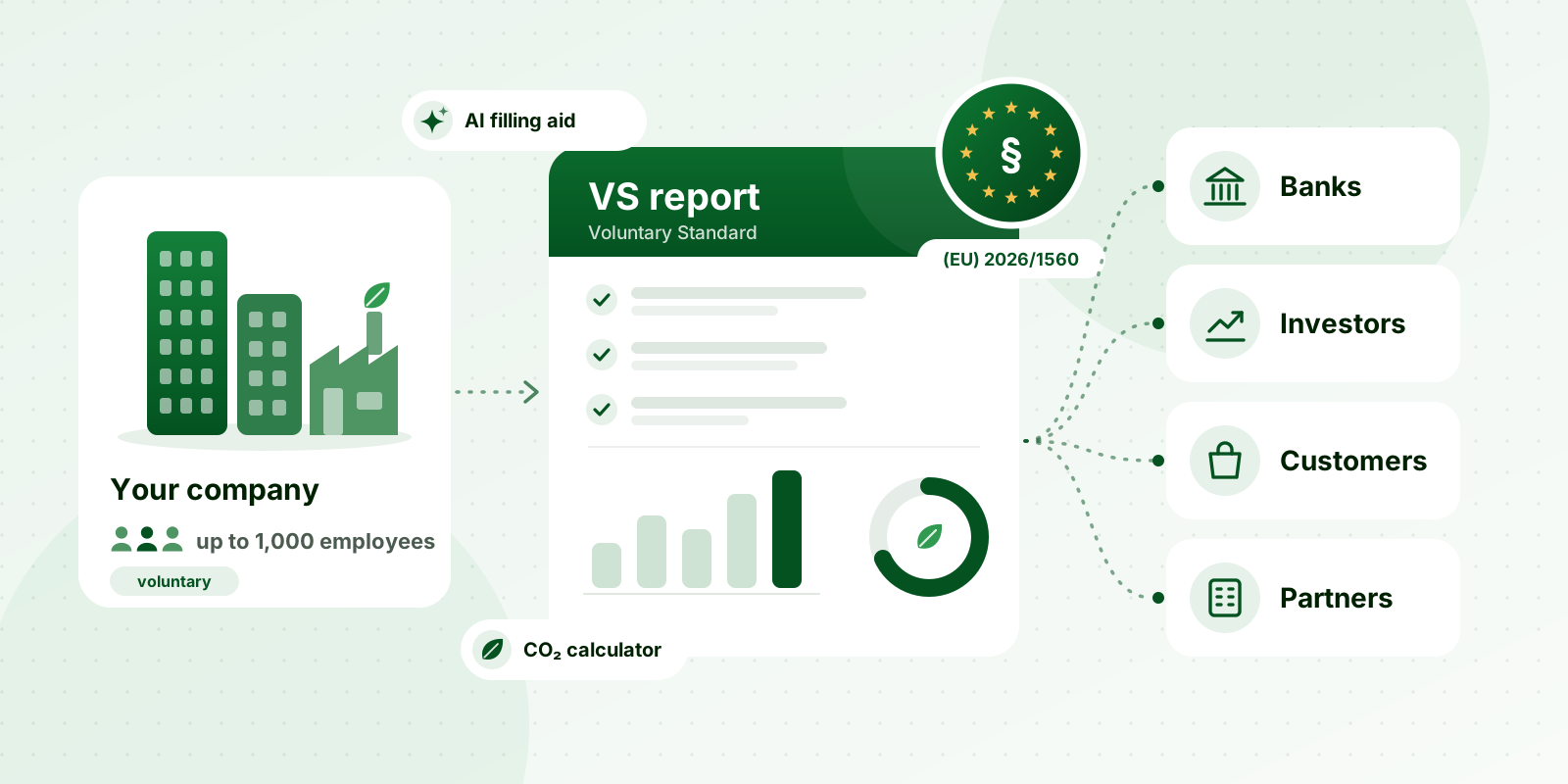
CSRD or Voluntary Standard – which standard applies to my company?
The new EU rules have significantly reduced the scope of mandatory sustainability reporting.
When is a company subject to the CSRD?
Under the new rules, the general CSRD reporting obligation applies to companies that meet both of the following criteria:
- more than 1,000 employees and
- more than €450 million in net turnover.
The balance sheet total no longer plays a role for this new CSRD threshold.
The former special rule for listed small and medium-sized enterprises no longer applies either. What counts are the new size criteria.
Companies that exceed both thresholds must prepare their sustainability reporting in accordance with the European Sustainability Reporting Standards (ESRS).
When is the Voluntary Standard relevant?
Companies that are not subject to mandatory CSRD reporting can report voluntarily under the new Voluntary Sustainability Reporting Standard (VS).
The EU developed the VS specifically as a proportionate and standardised framework for companies outside the CSRD.
It is particularly suitable for companies that want to provide sustainability information to banks, customers, business partners, investors or their supply chain.
Can a company switch from the ESRS to the Voluntary Standard?
Yes – if, because of the new EU thresholds, it is no longer subject to the CSRD.
With the CSRD thresholds raised, companies that had to report under the ESRS according to the previous rules may now fall outside the mandatory scope.
Example: A company with 800 employees and €300 million in turnover is no longer subject to the CSRD under the new rules. It therefore no longer has to report under the ESRS and can apply the Voluntary Standard voluntarily instead.
Switching from the ESRS to the VS is therefore possible once the statutory CSRD reporting obligation no longer applies.
When is the Voluntary Standard not enough?
If a company still exceeds both CSRD thresholds – more than 1,000 employees and more than €450 million in net turnover – it remains subject to the CSRD.
In this case, a voluntary VS report cannot replace mandatory ESRS reporting.
What does the Voluntary Standard mean for the supply chain?
The VS is also the basis for the new value chain cap.
For their own CSRD reporting, companies subject to the CSRD may, as a rule, not request sustainability information from companies with up to 1,000 employees that goes beyond the scope of the Voluntary Standard.
The VS is voluntary, however: a company outside the CSRD is not obliged to prepare a VS report.
With a VS report, however, a company can provide its sustainability information in a standardised way and answer many typical ESG requests from banks, customers and business partners more efficiently.
The simple decision
More than 1,000 employees AND more than €450 million in turnover?
→ CSRD / ESRS
Not both thresholds exceeded?
→ no general CSRD reporting obligation
→ Voluntary Standard possible on a voluntary basis
The new Voluntary Standard thus gives SMEs in particular a uniform way to provide sustainability information in a structured, transparent and EU-compliant form.
Sustainability reporting that suits SMEs – from €890/year.
Completely transparent terms. Secure, sustainable hosting in Germany. Fully ESG-compliant and ready to deploy instantly.
Is voluntary ESG reporting mandatory or optional for my SME under sustainability standards?
The Voluntary Standard (VS) was developed specifically for companies that do not (yet) fall under the regulatory reporting requirements of the Corporate Sustainability Reporting Directive (CSRD). Consequently, they have no direct statutory obligation. However, market dynamics are creating a powerful indirect mandate: Customer Requirements: Large corporates subject to CSRD compliance must report on their entire supply chain. They will therefore mandate the disclosure of essential ESG data from their suppliers – meaning you. A lack of ESG reporting can rapidly become a disqualifying factor. Financing Conditions: Banks and institutional investors are legally obligated (e.g., under the EU Taxonomy) to assess the sustainability performance of their investment portfolios and borrowers. A standardised ESG report serves as the data foundation for this, increasingly becoming a prerequisite for credit approvals or securing preferential terms. Conclusion: The Voluntary Standard (VS) report is your proactive, strategic response to the tangible requirements of your key business partners. With ESGLift, you can meet these compliance demands efficiently and professionally.
What is the specific relationship between the CSRD, ESRS, and the new VS standard for ESG reporting?
The short answer: Think of it as a modular system. The CSRD is the legislation, the ESRS are the complex building blocks for large corporations, and the Voluntary Standard (VS) is the tailored, simplified framework for SMEs. The detailed explanation: It is crucial to distinguish between these three concepts: CSRD (Corporate Sustainability Reporting Directive): This is the EU regulation. It mandates that specific (primarily large) companies must publish sustainability disclosures. It serves as the legal framework. ESRS (European Sustainability Reporting Standards): These are the granular reporting standards. They dictate precisely what and how large, CSRD-compliant organisations must report. The ESRS are highly comprehensive and complex. Voluntary Standard (VS): This is the proportional ESG reporting standard for SMEs. It was developed to enable smaller enterprises to meet market demands and supply chain requirements without being overwhelmed by the extensive scope of the ESRS. Crucially, the Voluntary Standard (VS) is fully aligned with the ESRS, meaning the ESG data you provide can be seamlessly integrated by your ESRS-regulated business partners. Conclusion: By publishing a Voluntary Standard (VS) report, you speak the same ESG language as large enterprises and financial institutions, utilising a vocabulary tailored to your company's scale. Our software translates this framework into a simple, guided ESG reporting process.
What tangible business value does voluntary ESG reporting provide for my company if it is not legally mandated?
A professionally prepared ESG report is an investment that yields multiple returns: Improved access to capital: You provide banks and investors with the essential data required for their risk assessments. This accelerates financing processes and can lead to more favourable conditions. Stronger competitive position: Sustainability is increasingly becoming a decisive awarding criterion in public and private tenders. With a Voluntary Standard (VS) report, you clearly differentiate your company from competitors and secure 'preferred supplier' status. Efficient risk management: The ESG reporting process compels you to address future risks—from rising carbon pricing to new circular economy legislation. You identify vulnerabilities before they become critical issues. Identification of cost reductions: Analysing your consumption data, such as for your carbon footprint, frequently uncovers significant savings potential in energy, water, or material usage. Enhanced employer branding: The younger generation of professionals specifically seeks employers with a proven commitment to sustainability. A transparent ESG report is a powerful asset in the war for talent. Conclusion: ESGLift delivers not only your finalised report, but also the data and insights to make your business more future-proof, efficient, and attractive to stakeholders.
Strategic value in ESG reporting
The strategic value of a Voluntary Standard (VS) report for your SME
Securing Access to ESG Financing
Financial institutions are increasingly tightening their assessment of ESG risks. A standardised Voluntary Standard (VS) report provides the necessary evidence, enhancing your eligibility and terms for corporate loans and green subsidies. Our software structures your data precisely to meet the requirements of bank risk assessment models in alignment with the EU Taxonomy.
Driving Sustainable Value and ESG Excellence in the Supply Chain
Large enterprises are required to report on their supply chain under the CSRD. By proactively publishing a Voluntary Standard (VS) report, you meet your clients' ESG requirements and secure existing and new business. This elevates your status from a mere supplier to a strategic partner with proven sustainability credentials.
Positioning our brand as an attractive employer of choice for ESG and sustainability talent
Professionals, especially younger generations, consciously choose employers based on their corporate values. Active and documented sustainability has become a decisive competitive advantage. Transparent ESG reporting serves as a powerful tool in recruiting and significantly enhances employee retention.